


 29 Sep 2026
A 3 p.m. temperature complaint is rarely just a thermostat problem. When one office is freezing, another is stuffy, and the conference room becomes uncomfortable as soon as it fills up, the system may no longer match how the building is used. An office HVAC retrofit gives property owners and managers a practical way to correct those issues without automatically replacing every component.
For New Jersey offices, the best retrofit plan balances comfort, energy use, equipment age, and business continuity. Some buildings need targeted controls and airflow corrections. Others need a larger redesign because the existing equipment is undersized, oversized, or nearing the end of its service life. The right answer comes from an on-site evaluation, not a one-size-fits-all equipment quote.
Start With How the Office Actually Operates
An HVAC system may have been designed for a different tenant layout, occupancy level, or work schedule. A former private-office floor can become an open-plan workspace. A storage room can become a server room. Hybrid schedules can leave parts of the building lightly used for several days, then fully occupied for meetings or training.
Before selecting equipment, document where comfort problems occur and when they occur. Note warm and cold zones, rooms with persistent odors, areas with excess humidity, and spaces where employees use portable fans or space heaters. Those workarounds are useful clues. They often point to poor air distribution, limited ventilation, or zoning that no longer reflects the floor plan.
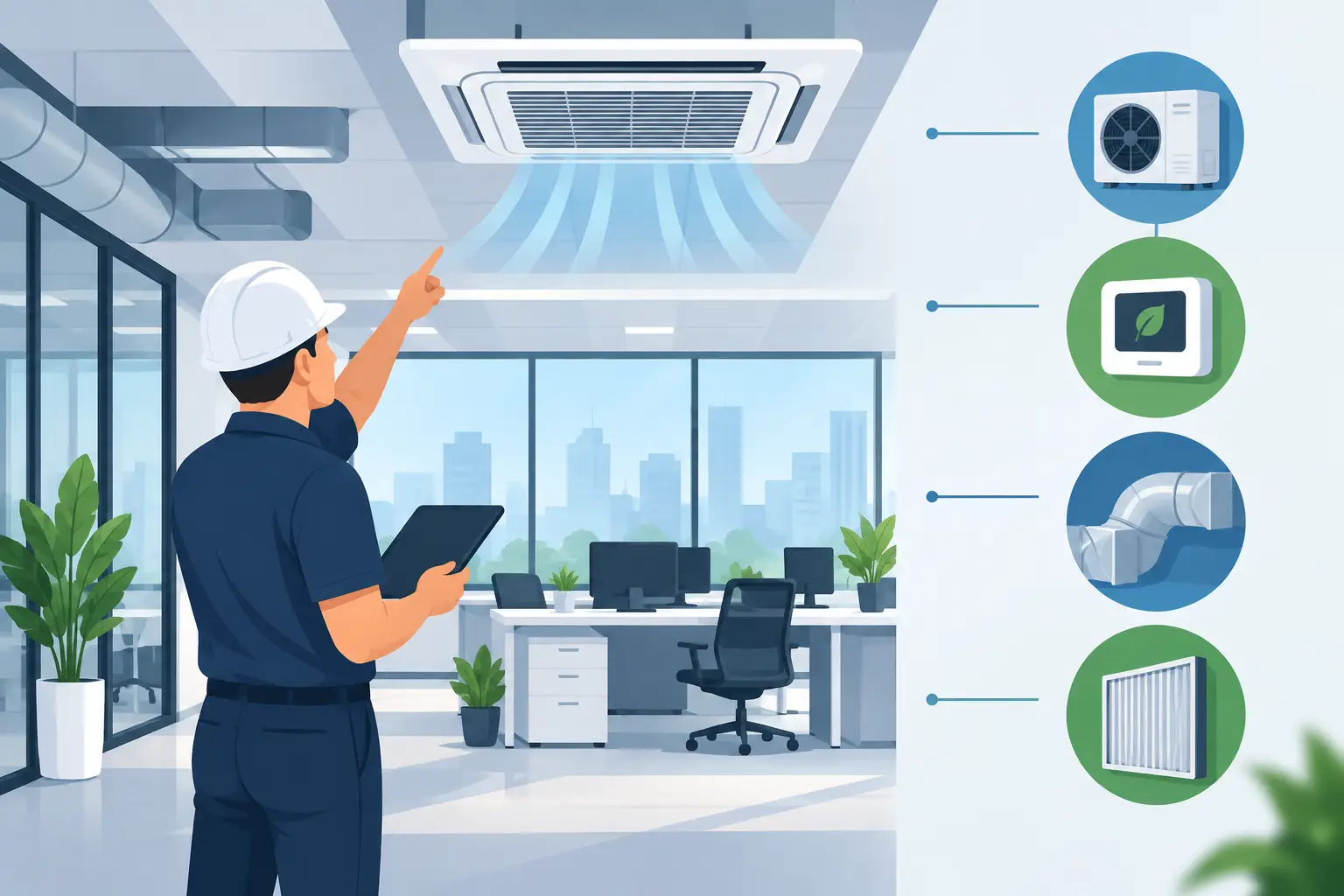
A professional assessment should also look beyond the indoor units. Duct condition, rooftop equipment performance, refrigerant levels, electrical capacity, ventilation rates, thermostat locations, and building-envelope issues can all affect results. Replacing a unit without addressing a crushed duct run or an improperly placed sensor can leave the original complaint unresolved.
Know When an Office HVAC Retrofit Makes Sense
A retrofit is often the smart middle ground between repeated repairs and a full system replacement. It is especially valuable when the building has a sound mechanical foundation but needs better control, distribution, efficiency, or capacity in selected areas.
Consider a retrofit when utility costs have climbed without a clear change in operations, comfort complaints are concentrated in certain rooms, or the system runs constantly without maintaining the set temperature. Frequent repairs, uneven humidity, noisy equipment, and poor indoor air quality are also signs that the existing setup deserves a closer review.
Age matters, but it is not the only factor. A well-maintained unit can sometimes support strategic upgrades. On the other hand, investing heavily in controls or duct modifications for equipment that is close to failure may not be the best use of capital. A technician should compare the remaining expected life of the equipment against the cost and benefit of the proposed work.
What to Upgrade First in an Office HVAC Retrofit
The most effective projects address the biggest operational problem first. That may be air distribution rather than heating or cooling capacity. It may be ventilation rather than a new thermostat. A clear scope prevents a business from paying for impressive-looking upgrades that do little for employee comfort.
Controls and zoning
Older offices commonly rely on one thermostat to manage several rooms with very different heat loads. Sun-facing offices, conference rooms, copy areas, and spaces with computer equipment can all need different levels of cooling throughout the day.
Modern programmable or smart controls can improve scheduling, provide remote monitoring, and reduce conditioning in unoccupied areas. Adding zoning can give separate parts of the office more appropriate temperature control. Zoning is not always simple, however. It requires the equipment, ductwork, and control strategy to work together. Poorly designed zones can create airflow and equipment-cycling problems, so the design matters as much as the thermostat.
Airflow and ductwork
A new high-efficiency unit cannot compensate for ductwork that leaks, is undersized, or fails to deliver air to the rooms that need it. Duct repairs, sealing, insulation, balancing, and diffuser adjustments can make a noticeable difference in comfort and operating cost.
Air balancing is particularly important after tenant improvements or layout changes. It measures and adjusts airflow so each area receives the amount of conditioned air it needs. This is often a lower-disruption improvement than replacing an entire system, and it can reveal whether a more extensive upgrade is truly necessary.
Ventilation and indoor air quality
Comfort includes more than temperature. Offices need sufficient outdoor air and proper filtration to manage odors, airborne particles, and carbon dioxide buildup. When meeting rooms feel stale or employees report recurring stuffiness, ventilation should be part of the conversation.
Possible improvements include upgraded filtration, dedicated outdoor-air strategies, energy recovery equipment, and air quality monitoring. The right approach depends on occupancy, the building’s existing ventilation path, and the capabilities of the current equipment. Higher-grade filters can help capture smaller particles, but a filter that is too restrictive for the system can reduce airflow. Proper sizing and installation protect both air quality and equipment performance.
Equipment replacement where it delivers value
If a rooftop unit, furnace, heat pump, or air handler is unreliable or inefficient, replacement may be the strongest long-term option. Newer commercial equipment can offer improved efficiency, variable-capacity operation, better controls integration, and more consistent comfort.
Still, replacement should be sized from current building conditions, not from the nameplate on the old unit. An oversized system may short-cycle, waste energy, and struggle with humidity control. An undersized system may run continuously during peak weather. A load calculation and site review help determine the appropriate capacity and equipment type.
For offices with difficult additions, isolated hot spots, or after-hours areas, ductless mini-splits can sometimes provide a targeted solution. They are not a replacement for a complete central-system plan in every building, but they can be effective where extending ductwork is impractical.
Plan the Work Around Your Business
An office HVAC retrofit should improve operations, not interrupt them. Ask for a phased plan that identifies what can be completed before or after business hours, what areas may need temporary access restrictions, and whether any work requires a planned shutdown.
Lead times also matter. Controls, rooftop equipment, electrical upgrades, and custom ductwork may have different scheduling requirements. A contractor should explain the sequence clearly, including permits, equipment delivery, installation, commissioning, and final testing.
Commissioning is the step that turns installed equipment into a working solution. It includes verifying airflow, refrigerant performance, controls operation, safety functions, and temperature response. Without it, even quality equipment can underperform from day one.
Measure Results After the Upgrade
Set a baseline before work begins. Review utility bills, maintenance history, temperature complaints, and current operating schedules. After the retrofit, compare those records with new energy use and comfort feedback over several seasons.
Energy savings are valuable, but they should not be the only measure of success. Fewer hot and cold calls, better meeting-room comfort, lower humidity, reduced repair needs, and more predictable operating hours can all improve the value of the project. A maintenance plan protects that investment by keeping coils clean, filters changed, drains clear, and controls calibrated.
For office owners and managers in Middlesex County and across New Jersey, Tamco Air can evaluate the condition of an existing system and recommend a retrofit scope built around the building’s real needs. The most useful next step is a thorough assessment that identifies the source of the problem before work begins, so your office can stay comfortable without paying to replace what still works.